

Your company has commissioned a corporate video, the final cut looks polished, and the team is ready to approve it. But does the delivery package actually work on your website, in presentations and on the channels where the campaign will run? Are the Arabic and English versions correct? Can the business reuse the content under the agreed rights?
A final viewing is only one part of acceptance. A practical handover checks the exported files, platform-specific crops, message and captions, rights documentation, approved versions and where the files will be stored. The contract and creative brief decide what is included: a horizontal master does not automatically mean vertical cutdowns, source project files or unlimited future edits.
The short answer: before signing off a corporate video, confirm the deliverables list, test each exported version in its intended placement, inspect subtitles and audio, document agreed usage rights, and record one final approval against clearly named files. A useful checklist prevents a good video from becoming an unusable campaign asset.
Start with the destinations, not the export button
List the actual places the video will appear. A website hero, meeting-room screen, sales presentation, YouTube campaign and vertical short-form ad may have different framing or technical requirements. Do not assume a single 16:9 file can be automatically cropped without cutting off a product demo, speaker or on-screen text.
For Google video campaigns, Google's own specifications describe horizontal 16:9, square 1:1 and vertical 9:16 assets with format-dependent requirements. These are platform-specific guidelines, not a rule that every client must commission all three. Consult the current specification for the exact campaign before final approval: https:/
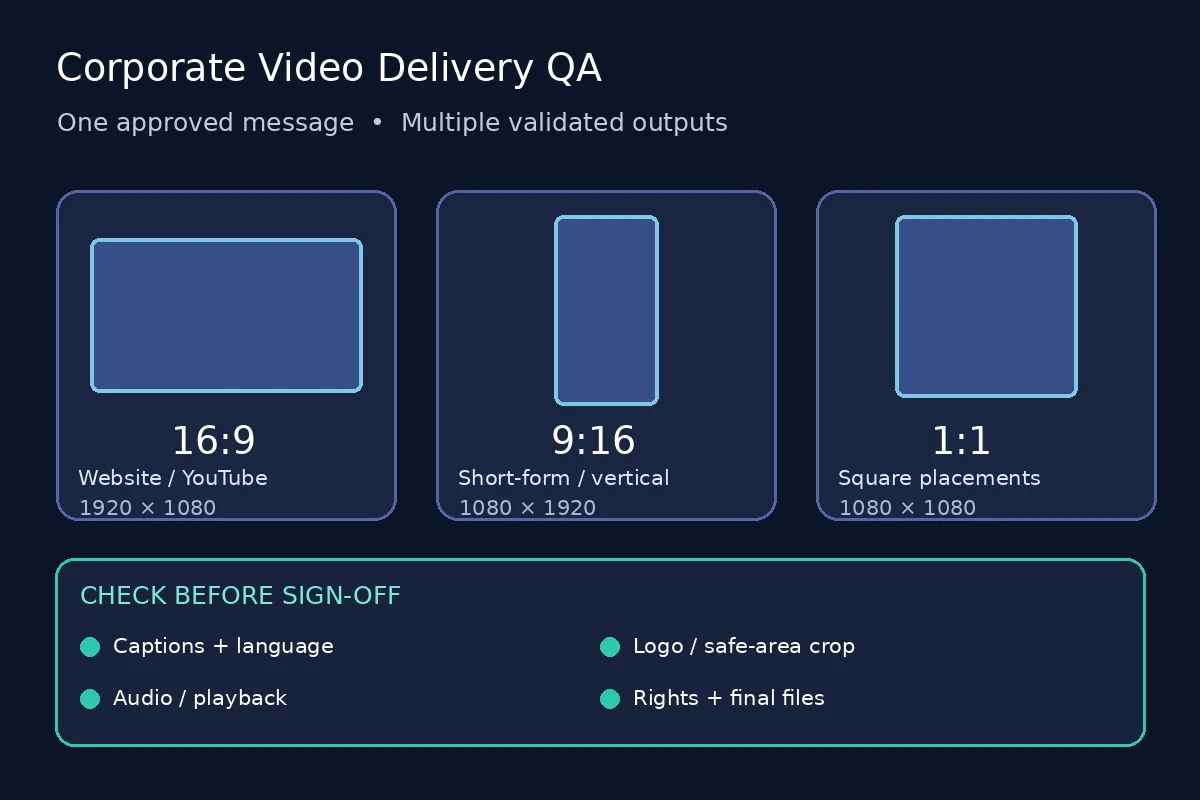
The corporate-video delivery matrix
Use this worksheet in the creative brief and again at handover. For every requested asset, enter the destination, planned length, aspect ratio, language, captions, owner and acceptance result. The following rows are illustrative rather than a universal package.
| Asset | Acceptance checks |
|---|---|
| ASSET A — Full corporate video: | primary website or presentation use; confirm intended framing, target resolution, brand messages, audio and the agreed final runtime. |
| ASSET B — Short marketing edit: | a separate shorter cut if commissioned; confirm the opening message and call to action still make sense without the full story. |
| ASSET C — Vertical social version: | if needed, test the actual crop on a mobile screen, checking faces, demonstrations, logos and subtitles at the edges. |
| ASSET D — Square or alternate placement: | include only where the media plan calls for it; do not assume the original horizontal edit automatically becomes a new finished cut. |
| ASSET E — Arabic-language version: | when commissioned, verify translation meaning, names, pronunciation, terminology, caption direction and actual visual fit. |
| ASSET F — Caption and transcript package: | confirm the agreed embedded captions or separate subtitle files, text accuracy, speaker identification where appropriate and any accessibility requirements. |
| ASSET G — Thumbnail, stills and poster frame: | only if listed; check branding and whether the image works on the target placement. |
| ASSET H — Archived master and future-use files: | define exactly what the client receives, how the versions are identified and what project/source files, if any, are contractually included. |
Three acceptance tests often missed by busy marketing teams
1. Crop and safe placement. Open every version on the target device or preview tool. Look for clipped logos, titles behind platform controls and faces cut at the edges. A resize is not necessarily a considered reframing. Google documents video safe-area guidance and asset orientation requirements for its own campaigns: https:/
2. Audio and captions. Listen through headphones and phone speakers. Check dialogue intelligibility, music balance, silence at the beginning/end and captions against what is actually said. For bilingual versions, a language reviewer should check meaning rather than only spelling.
3. Campaign message and CTA. Freeze the last frame and ask whether the viewer knows the next step. Verify the correct URL, phone or contact route where it appears on screen. An otherwise excellent export may still be commercially unusable if it sends a viewer to an old campaign page.
A concrete example: one video, three approval results
Consider a hypothetical UAE B2B company commissioning a ninety-second overview for its website plus a fifteen-second vertical cut. The full horizontal version passes after a brand review. The vertical edit fails because the product demonstration is cropped and a subtitle sits behind the app interface. The Arabic caption version is marked NEEDS DECISION until a qualified bilingual reviewer checks technical terms.
The correct response is not to approve the entire project because one version looks good. Record each deliverable separately, identify the defect and owner, request a corrected export, and recheck only the affected outputs plus any dependent versions. This is a fictional illustration, not a DevelopPrism project result.
An easy approval register
Record one line per file:
- Filename, version and date
- Intended placement, format, aspect ratio and duration
- Required language and caption type
- Reviewer and review date
- Status: PASS / CHANGE REQUESTED / NEEDS DECISION / NOT IN SCOPE
- Exact issue with timestamp, screenshot or permitted reference
- Person responsible for correction
- Link to corrected version and final business approval
Use timecoded comments such as “00:12: logo clipped in vertical crop” rather than “make it more professional”. Establish a cut-off for consolidated feedback and which revisions are included under the actual agreement. The register helps both marketing and production teams work from the same approved version.
Rights and editable files: ask for a written handover
A finished export, original camera footage, music licence, font, stock footage licence, transcript and editable project file are different deliverables. You should not assume that receiving an MP4 gives you all underlying materials or unrestricted future use.
Ask the producer to identify which usage contexts are permitted, whether paid advertising is covered, what third-party assets have conditions, whether any talent or location permissions affect reuse, and which source files are included or excluded. Do not assume a universal UAE ownership rule or rely on a generic online statement; contractual rights and applicable law require case-specific review. This article is a procurement checklist, not legal advice.
When planning a shoot, agree the distribution rights and intended outputs early because they influence production decisions. For a separate treatment of budgets and scope, see https:/
A five-step sign-off process
Step 1 — Confirm the creative brief and signed deliverables schedule; remove outputs that were never commissioned.
Step 2 — Validate files and technical playback at the actual channel placement.
Step 3 — Run brand, subject-matter, language and any legal/compliance reviews that your business requires.
Step 4 — Resolve open change requests, then archive the final named versions and usage documentation.
Step 5 — Record the accountable business owner’s acceptance, outstanding limitations and an accessible handover location.
If the company plans to reuse the production for campaigns later, keep a simple master manifest. It prevents staff from accidentally reusing a superseded cut or an asset outside its intended permission.
Frequently asked questions
What files should a corporate video production company deliver?
The precise list should be in the approved scope. A typical request may include a final high-quality master and a compressed delivery copy; short edits, vertical crops, subtitles, thumbnail images, raw footage and editable project files must be explicitly agreed rather than assumed.
Do I need separate horizontal and vertical corporate videos?
Only if the distribution plan calls for them. Google Ads supports different orientations for different placements, and a vertical composition can require different framing. The safest approach is to define the channels first and then test each commissioned export on its destination.
Should a UAE business receive raw footage and editing project files?
That is a contract question, not an automatic entitlement. Ask which originals and editable files are included, which depend on third-party licences or specialized software, and how they can be transferred and reused. Record ownership and licence terms in writing.
How do I check Arabic and English subtitles before approval?
Have a language reviewer compare the captions to the actual spoken message, including names, technical terms and calls to action. Test line length, readability and positioning in every delivered orientation. Do not infer accuracy merely because an automated transcription tool produced the subtitles.
Can a corporate video be reused in paid ads?
It depends on the rights granted for the footage, music, performers, stock assets and other third-party materials, plus the platform’s technical and policy requirements. Confirm paid-use scope in writing and validate the export against the intended campaign specifications before launch.
How many revisions should be included in video production?
There is no universal number. The agreement should define revision rounds, response windows, what counts as a change to the original brief, and approval deadlines. Consolidate feedback and provide timestamped notes so the team can assess changes clearly.
How DevelopPrism can help
If you are planning a corporate video in Dubai or elsewhere in the UAE, start with the business result and the destinations where the finished assets must work. DevelopPrism's video-production service provides a route to discuss creative scope, production requirements and the handover you expect: https:/
Share the intended platforms, languages, deliverable types, campaign deadline and who will approve the final video. We can discuss a scoped production proposal based on those requirements; exact format packages, revision terms, rights and production capabilities must be agreed before work starts. Submit your brief at https:/