

Your company is about to approve a new visual identity. The logo looks right in a presentation, but what will happen when the Arabic and English names appear on a shop sign, mobile website, invoice, delivery box or social profile? The point of a brand identity approval is to catch those deployment problems while changes are still manageable.
For UAE businesses working across Arabic and English, the safest sign-off process tests each version in realistic use, assigns a reviewer and records exceptions. A polished logo is not the same thing as a complete, usable brand identity system.
The short answer: approve bilingual naming, typography, layout direction, real-world applications, asset rights and the final file handover separately. Record PASS, CHANGE REQUESTED, NEEDS DECISION or NOT IN SCOPE for each asset. Do not approve an entire identity because a single presentation slide looks attractive.
Define exactly what is being approved
Ask the designer and the business owner to agree the deliverables inventory. That might include a primary logo, Arabic and English wordmarks, dual-language lockups, positive/negative variants, vector masters, color references, typefaces, social icons, stationery templates and a short usage guide. No particular asset is automatically included: the agreed scope and contract define the package.
Give every item a proposed use and reviewer. For example, a brand manager may approve visual consistency, a qualified Arabic reviewer may approve language and readability, and an operations manager may approve whether a sign or packaging design can actually be produced. Legal ownership questions need competent legal review, not assumptions based on a file download.
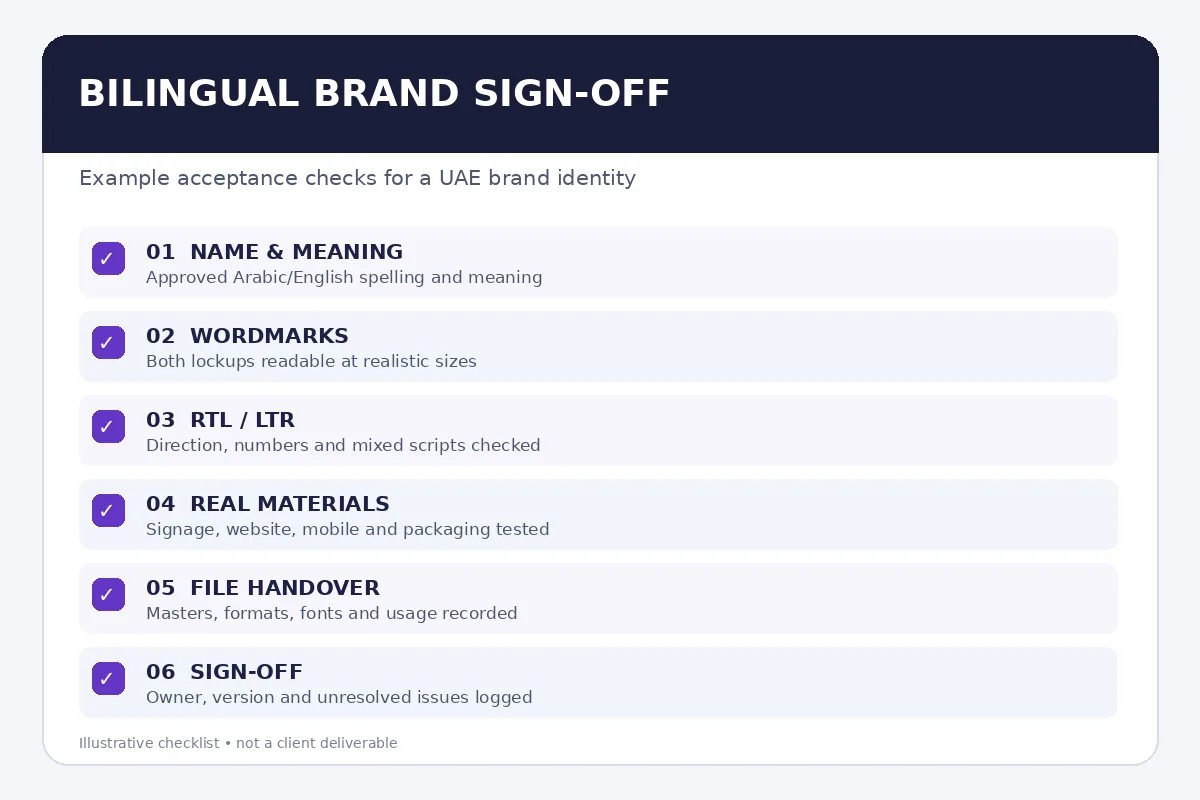
The 12-check bilingual brand approval matrix
Use the following as an illustrative acceptance worksheet. Each row requires evidence, a responsible reviewer and a recorded outcome.
| Approval check | Evidence and review |
|---|---|
| 1. Name approval. | Confirm the authorized English and Arabic names, whether the Arabic form is translation, transliteration or a separately approved trading name, and whether spelling is consistent with the organization's verified records. Do not assume that visually attractive lettering establishes trademark clearance. |
| 2. Meaning and pronunciation. | Ask a qualified Arabic-language reviewer to check whether the name and key taglines make sense to the intended audience. Avoid approving a literal translation that loses the business meaning. |
| 3. Arabic and English wordmarks. | Compare both versions at matching real-world sizes. Check whether letter proportions, spacing and visual emphasis feel related without forcing Arabic script to imitate Latin letter construction. |
| 4. Small-size legibility. | Test at realistic social avatar, website header, app tile and printed-business-card sizes. A detailed lockup may require a separately approved simplified variant. |
| 5. Light/dark applications. | Check the logo on white, dark and photographic backgrounds, plus single-color applications where included. Use design-approved variants rather than ad-hoc recoloring. |
| 6. Typography pairing. | Identify the licensed Arabic and Latin families, weights and fallbacks for actual digital or print use. Test headings and body copy, not just isolated sample letters. |
| 7. Right-to-left reading order. | Check Arabic layout on a real phone and desktop canvas. W3C explains that Arabic-script content is typically right-to-left, while embedded numbers and Latin passages can retain left-to-right order. Don't simply flip the entire English mockup; test mixed phone numbers, URLs and brand labels. |
| 8. Copy and bilingual hierarchy. | Decide where Arabic, English or both appear, and which message leads on each asset. Confirm names, addresses, calls to action and contact details before mass reproduction. |
| 9. Digital use and accessibility. | Test web header, navigation, buttons and profile imagery. WCAG 2.2 treats logotypes differently from ordinary text contrast: text that is part of a logo has a specific exception, but interface text and controls must still meet applicable requirements. A low-contrast logo should not be used as an excuse to make the rest of the page unreadable. |
| 10. Physical applications. | Test at least one production-relevant use: signage, packaging, uniform, vehicle graphic, exhibition stand or printed stationery. Confirm realistic dimensions, material constraints and artwork requirements with the actual supplier. |
| 11. Usage rights and ownership records. | Identify which source files, fonts, photographs, illustrations and licences can be transferred and reused. Seek appropriate UAE trademark and legal advice when rights, clearance or filing are material; brand approval does not itself secure legal registration. |
| 12. Handover and rollback. | Confirm the asset folder, file names, version history, an owner for future requests and a list of legacy assets that must be replaced. Keep an approved archive so teams can distinguish the final identity from withdrawn concepts. |
How to document the sign-off
Do not rely on a WhatsApp message saying “looks good.” For each item in the matrix, record:
- Asset name and unique version number
- Arabic, English or bilingual variant
- Intended use and the test preview
- Reviewer and date
- Outcome: PASS, CHANGE REQUESTED, NEEDS DECISION, NOT IN SCOPE
- Problem description and annotated evidence
- Correction owner and agreed recheck
- Final owner sign-off and approved download location
A CHANGE REQUESTED result needs a revised artifact. NEEDS DECISION means the business specification remains unsettled. NOT IN SCOPE must be explicit so the business cannot mistakenly assume an asset will arrive later. A PASS applies only to the reviewed version and use, not automatically to every possible adaptation.
A practical UAE launch example
Imagine a fictional Dubai retailer choosing an identity for its ecommerce website, delivery packaging and a physical storefront. Its English primary logo passes the website header test. The Arabic/English storefront lockup needs changes because the Arabic line is unreadable at the approved sign size. The packaging proof needs a decision about bilingual product descriptors. The social avatar passes only with the simplified icon.
The retailer should approve the tested website master while withholding sign and packaging approval. It then asks for corrected proofs and rechecks only affected dependencies. This is an illustrative workflow, not an actual DevelopPrism client result or a legal determination.
Check bidirectional text, not just Arabic spelling
Arabic text running right-to-left can include phone numbers, website URLs and English product names that run left-to-right. The W3C Arabic/Persian layout requirements and web internationalization guidance distinguish script direction from surrounding text direction. For an actual bilingual website, the implementer should use meaningful language and direction attributes rather than relying on a translated image alone. See https:/
A static proof might conceal a problem that appears only when text wraps, when a font fallback loads, or when the width changes. Review mobile screens and print-ready compositions using the actual content. Take care not to mirror brand marks, product photographs, maps or icons indiscriminately; decide directionality by meaning and the intended interaction.
Separate brand design from trademark clearance
A designer can provide visual concepts and a sign-off record, but that does not mean the business name or graphic is legally cleared. The UAE Ministry of Economy and Tourism maintains official trademark registration services, including application requirements. Review the current official process at https:/
What a complete brand handover can look like
The actual contract governs delivery, but a buyer can request a clear manifest:
- Primary and alternative lockups in final usable formats
- Editable vector masters when contractually included
- Digital exports sized for agreed channels
- Color specifications and approved background use
- Font names, license/usage notes and replacements where applicable
- Arabic/English spelling and terminology reference
- Guidelines showing spacing, incorrect uses and examples
- Templates and mockups listed in the scope
- Design/source file ownership and third-party licence notes
- Contact person and process for changes after the handover
Ask the team to demonstrate that the files open in the software and systems your organization actually uses. A zipped folder is not a successful handover if the files are inaccessible or key usage decisions remain unclear.
The go/no-go decision before rollout
Release the identity only when the critical uses needed for launch have a PASS, required approvals are documented and unresolved issues have owners and deadlines. Optional future assets can remain NOT IN SCOPE. Where an issue could cause wrong Arabic wording, illegible signage or a rights conflict, hold that particular deliverable and obtain the relevant correction or professional review.
A phased rollout may be sensible, provided the company knows which old assets are still in circulation. Keep a dated change list for website graphics, social profiles, customer documents, physical signage and printed inventory. Assign a single accountable brand owner who knows where the approved master files live.
Frequently asked questions
What should a bilingual UAE brand identity package include?
It depends on the commissioned scope. At minimum, request clear Arabic/English naming decisions, the logo versions you will use, production-ready formats, color and type specifications, and usage instructions. If social templates, signage artwork, packaging or editable source files matter to your business, list each one before contracting.
Does an English logo need a separate Arabic version?
Not necessarily for every company or every channel. Some businesses use one bilingual lockup, others have separate approved language versions. Test what your audience and placements require. Where Arabic text is presented, have a qualified reviewer check meaning, readability and visual fit.
What is the difference between brand guidelines and an approval checklist?
Brand guidelines describe how to use the identity after approval. An approval checklist records whether each proposed asset has been tested, by whom, against which expected use and with what result. Ideally the final approved assets and the guidelines agree.
Who should sign off Arabic brand copy and RTL layouts?
The business should designate a qualified Arabic-language reviewer for wording and an appropriate designer or web implementer for layout behavior. A legal or regulatory reviewer may be needed for claims, names or industry-specific restrictions. The final owner should approve the complete release record.
How do we test our new identity before printing signage?
Use scale-appropriate proofs with the sign supplier, checking readable sizes, color/material limits, bilingual hierarchy and viewing conditions. Confirm the actual spelling and production-ready artwork. Do not substitute a laptop mockup for a supplier-approved production proof.
Does receiving logo source files mean we own all rights?
No general assumption is safe. Ownership and permitted use depend on the contract, original assets and any third-party licences, and some questions require legal review. Record exactly which editable files and rights have been transferred. Design approval and trademark registration are separate matters.
How DevelopPrism can help
A UAE business commissioning a new identity can get more useful proposals by preparing its approved names, audience, language needs, first-priority channels and the expected deliverables. DevelopPrism's branding and design service is the appropriate starting point for discussing visual identity requirements: https:/
Send your existing assets, intended Arabic and English uses, launch priorities and approval constraints through https:/