
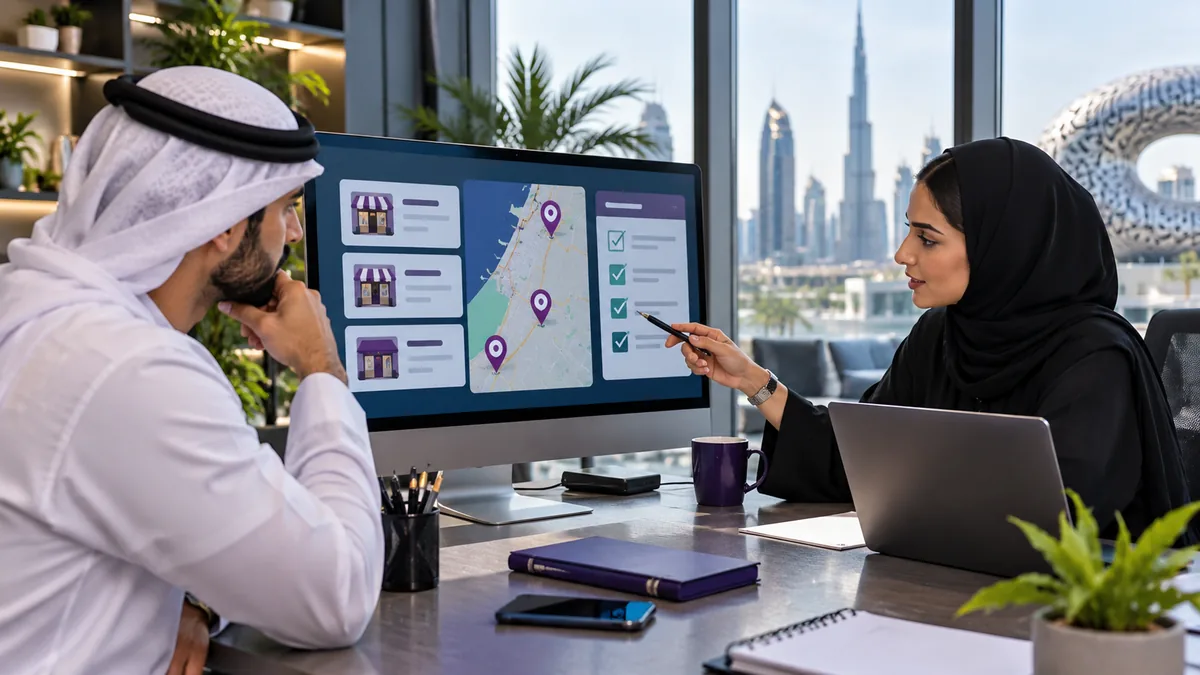
A business operating in Dubai, Abu Dhabi and Sharjah can have one brand but three very different local-search situations. One branch may welcome customers at a staffed storefront. Another may serve customers from a real operating base without inviting walk-ins. A third “office” may be only a postal or virtual address. Treating them all as identical Google Maps locations can lead to misleading listings and a maintenance problem.
The first question is not “How many city landing pages can we publish?” It is “Which locations actually qualify, what useful information should customers receive for each, and who owns that information after launch?”
The short answer: make an evidence-backed inventory of the business’s real operating locations; decide Business Profile eligibility separately for each; publish a distinct branch webpage only where it helps users; then assign an accountable owner for hours, addresses, phone routes, services, reviews, images and technical SEO. Google’s policy does not permit creating profiles for virtual offices that are not genuinely staffed and operating.
Why multi-branch local SEO is a governance task
A local SEO agency can configure the website, but it cannot know that a branch has changed its Friday hours unless the business tells someone. A store manager may know the accurate hours but cannot necessarily edit schema or URLs. A web team can fix the location landing page while an old telephone number remains in the Business Profile.
A workable system separates three records: the actual business location, the Google Business Profile (where eligible), and the corresponding website page (where useful). These are related, but they are not interchangeable.
Google’s official guidelines for representing businesses govern Business Profile eligibility and representation: https:/
Step 1: Classify every branch before creating or editing a profile
Use an internal list of actual operations, rather than a target-city keyword list. For each location, record one of these cases.
CUSTOMER-FACING STOREFRONT — Customers can visit during stated hours; the business has the real-world signage, staffing and address required by Google’s guidelines. Candidate for a location profile, subject to all applicable requirements.
SERVICE-AREA OPERATION — A business travels to customers. Google’s rules allow appropriate service-area profiles, and separate profiles for genuinely separate staffed locations with their own service areas. A service-area business without a customer-facing storefront should normally hide its address. Do not create a new profile merely because the company serves another emirate.
SHARED OR CO-WORKING SPACE — A rented desk or postal facility alone does not qualify. Google identifies clear signage, customer reception and staffing conditions for co-working offices. Verify real operating facts before adding a pin.
VIRTUAL OR MAILING ADDRESS — Not eligible merely as an address. Google explicitly excludes virtual offices that do not operate there.
TEMPORARY SALES TERRITORY — Selling to customers in a city does not automatically establish a separate location. A legitimate city service page might still explain coverage if it offers real customer value, but that does not create Business Profile eligibility.
A fictional company with a staffed Dubai showroom and a Sharjah delivery service operating from one central office might have different profile needs. It cannot simply add “Abu Dhabi office” because a sales representative occasionally visits that emirate. Check the real organization and Google’s current category-specific rules.
Step 2: Assign the website page separately
Not every Business Profile requires a newly created, thin SEO landing page, and not every service area needs a profile. Consider a dedicated location page when it helps customers identify a real branch and offers genuinely distinct information: the address or service area, available services, operating hours, directions where appropriate, branch contact route, accessibility information, or appointment process.
Avoid publishing dozens of nearly identical city pages that simply change the emirate name and send everyone to the same generic contact form. Google’s Search spam policy describes doorway abuse involving substantially similar pages intended to capture similar geographic searches without useful distinct content: https:/
A genuine branch page can include the location’s authorized name, services actually available there, accurate contact methods, a map for publicly visitable storefronts, and updated operational details. If the branch has no real distinct facts or customer use, improve the existing general service page rather than fabricating a local page.
Step 3: Build a single branch authority register
Create one spreadsheet row for each verified location, with the following fields. The examples below are illustrative rather than real DevelopPrism client data:
Branch reference: a stable internal identifier, not the marketing nickname.
Operating model: storefront / service area / shared office / other.
Eligibility evidence: visible signage, on-site staffing, customer visit practice, and other category-specific requirements as applicable.
Correct business name and actual address: checked against the business’s records; show or hide the address as required.
Primary phone and routing owner: the number should reach the intended location where feasible and be controlled by the business.
Regular and special hours: business owner who verifies holiday or seasonal changes.
Services and category: actual local offering; do not duplicate a profile just to create another category.
Business Profile URL and owner: reference only after verified to belong to this business/location.
Website location page URL: only if genuinely useful; mark not applicable when a separate page is unnecessary.
Review-response owner and escalation: who answers, and what is done when a review describes a safety or service failure.
SEO/website owner: responsible for canonical, crawlability, mobile QA, structured data and content changes.
Last checked, next review, and open issues: proof of maintenance rather than one-time setup.
Give the register a designated business custodian. If nobody is accountable for each field, the spreadsheet will become another outdated representation of the company.
Step 4: Use this practical responsibility matrix
| Task | Accountable owner | Supporting role | Acceptance evidence |
|---|---|---|---|
| Verify whether a location actually operates | Operations director | Branch manager | Signed factual location record. |
| Check Business Profile eligibility and duplicates | Brand/operations owner | Local SEO specialist | Policy checklist and profile ownership proof. |
| Confirm branch hours and special hours | Branch manager | Customer service | Dated approval and updated public hours. |
| Check phone routing and appointment path | Customer service lead | Web/IT | Test call or enquiry at the correct branch. |
| Create or update useful branch webpage | Marketing owner | SEO and web team | Unique helpful content, working contact route, mobile QA. |
| Verify site technical SEO | Web/SEO owner | Marketing | Canonical, robots, indexability tests and accurate structured data. |
| Respond to reviews | Authorized customer experience owner | Branch manager | Dated response process, escalated exceptions. |
| Change business name or close a branch | Operations owner | SEO/GBP administrator | Change record and cross-channel update evidence. |
The person who knows the facts does not need to be the person who knows WordPress or Business Profile Manager. They do, however, need to be responsible for approving factual updates.
Step 5: Handle duplicates and profile ownership properly
An old listing may already exist for a genuine branch. Before creating a new one, search for the actual business name and address in Search and Maps, inspect account ownership, and follow Google’s ownership-request process where necessary. Do not add a duplicate merely because a former employee or agency controls the profile.
Google explains how duplicate profiles can be suppressed and how to resolve ownership issues: https:/
For companies with many genuine branches, Google supports bulk profile import and certain bulk verification procedures; bulk verification has eligibility conditions, including 10 or more eligible locations of the same business. Importing data does not itself complete verification. See https:/
Step 6: Check technical consistency without making location spam
Once real branches and useful webpages are confirmed, review the links between profiles and pages. A Business Profile should direct users to an appropriate, working page that actually represents that location. On the website, ensure each valuable branch page has a meaningful title, relevant content, logical internal links, one appropriate canonical and no unintended noindex.
Where LocalBusiness structured data is appropriate, use actual known facts and avoid inventing ratings, opening hours or addresses. Schema can help describe a business but cannot create a real branch, guarantee rich results, or make a page eligible for Google Maps by itself. Review Google’s current structured-data documentation: https:/
For multilingual sites, make sure the correct Arabic and English versions describe the same real location accurately; don't assume one translated page or copied location page solves local relevance.
Step 7: Set a change-event workflow
The most damaging local SEO issues often arrive after the project is declared finished. When a branch relocates, changes its telephone number, changes its weekend hours, closes, or adds a major service, use a simple ticket:
- Branch manager submits verified facts and an effective date.
- Operations approves the change and identifies any safety or customer impact.
- Google Business Profile and website owners update their respective records.
- Customer service tests contact routes and confirms working hours.
- Marketing verifies public accuracy and records completion.
Do not assume every platform updates instantly. If the change is time-sensitive, coordinate customer-facing notices and record unresolved dependencies.
A seven-point monthly branch audit
For every real location, mark PASS, ACTION NEEDED, NEEDS BUSINESS DECISION or NOT APPLICABLE.
- Profile eligibility and ownership: Does this still represent a real, eligible operation?
- Name, address and service area: Do customers receive truthful directions or coverage information?
- Customer-facing hours: Have normal and special hours been confirmed?
- Contact conversion: Does the branch telephone number, form or booking route work?
- Website relevance: Does any location-specific webpage help customers with actual local details?
- Reviews and customer questions: Are responses assigned and escalations resolved?
- Technical state: Are appropriate pages accessible and indexable, without broken canonicals or duplicate doorway-style pages?
Keep a dated exception log, not just a dashboard screenshot. For multi-branch organizations, a regular governance review can expose the branch that is losing enquiries because a phone routes to the wrong team.
How to interpret branch performance
Review each branch’s Business Profile interactions and website contact outcomes where data is available, taking account of Google’s reported metric definitions and attribution limitations. Separate branded and nonbranded searches when valid data supports doing so. Do not compare branches as if they share the same population, competition or service mix.
A higher number of profile views is not proof of qualified enquiries. For commercial decisions, connect each branch enquiry path to the receiving team and record whether the contact actually reached the correct location.
Frequently asked questions
Does every UAE branch need its own Google Business Profile?
No. Each proposed profile must reflect a real, eligible business location under Google's current rules. A staffed customer-facing location may qualify, and genuinely distinct staffed service-area operations may qualify under specific conditions. A city you serve, a mailbox or an unstaffed virtual office is not automatically another eligible branch.
Can we create Google Maps listings in Dubai, Abu Dhabi and Sharjah if we serve all three?
Not simply because you sell in those emirates. The existence and eligibility of actual staffed locations matter. Google’s policy distinguishes legitimate locations and service-area businesses from virtual addresses and duplicated listings. Plan profiles from operations evidence, not a city-keyword list.
Should each branch have a separate landing page?
Only when a separate page helps customers with genuine location-specific information. Real hours, local services, address or coverage, booking information and useful branch details can justify a page. Avoid near-identical pages made mainly to rank for multiple cities and funnel people to one generic destination.
Can several branches share one telephone number?
Google recommends a phone that connects to the individual business location where possible. A central number is not automatically banned, but a branch-level contact route should actually reach the right team. Test call routing and customer experience rather than adding unsupported local phone numbers.
How should we manage reviews across branches?
Give each location a named authorized reviewer and a clear escalation process. Replies should reflect what actually happened at the location, without invented responses or disclosure of private customer information. Operations should own resolution while marketing can support consistency and training.
How often should multiple Google Business Profiles be audited?
There is no universal fixed audit interval. Monthly operational checks are a practical starting point when hours, staff and services change often, with immediate updates for relocations, closures or serious contact failures. Set the frequency based on the number of branches and the cost of inaccurate public information.
How DevelopPrism can help
If your UAE business has multiple operating locations, start by identifying the real branches, current profile access, existing location pages and the people who receive local enquiries. DevelopPrism’s SEO service is the appropriate place to discuss a scoped assessment of local search structure and website content: https:/
For single-location setup basics, our existing Google Business Profile guide may be useful: https:/
Share the number of real branches, their operating models, existing profiles and the major issue you need fixed at https:/